
| The Current Caregivers Corner | Caregivers Corner Archives |
2003: | January |
February | March |
April | May | June |
2002: | Jan | Feb | Mar
| Apr | May |
Jun
| Jul | Aug | Sep/Oct
| Nov | Dec
|
2001: | Jan | Feb | Mar | Apr
| May
| Jun | Jul | Aug
| Sep/Oct | Nov
| Dec |
2000: | Jan | Feb | Mar | Apr | May | Jun | Jul | Aug
| Sep | Oct
| Nov | Dec
|
Caregivers Corner � April 2003
|
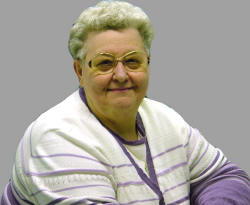 Meet
Agnes Puricelli, Dietary Manager for Governor�s Center in Westfield,
Massachusetts. In her small office on the ground floor of Governor�s
Center, Agnes talks of teamwork,
leadership, a supportive management staff and the importance of getting to
know the residents that call Governor�s home. In her role as Dietary
Manager, Agnes is responsible for managing all aspects of the foodservice
operation that serves approximately 100 residents. Her track record for
excellence has seen her through as a cook, an assistant food service
supervisor, a regional director, retirement, and back to food service
director. Her key to success? �My staff,� she says, �I couldn�t do it
without my staff.� Meet
Agnes Puricelli, Dietary Manager for Governor�s Center in Westfield,
Massachusetts. In her small office on the ground floor of Governor�s
Center, Agnes talks of teamwork,
leadership, a supportive management staff and the importance of getting to
know the residents that call Governor�s home. In her role as Dietary
Manager, Agnes is responsible for managing all aspects of the foodservice
operation that serves approximately 100 residents. Her track record for
excellence has seen her through as a cook, an assistant food service
supervisor, a regional director, retirement, and back to food service
director. Her key to success? �My staff,� she says, �I couldn�t do it
without my staff.�In recent years, liberalized dining has captured Agnes� attention. In the past, the approach to providing food service to elders was based out of an acute care model. Residents were placed on medical diets, dictated to them by their doctors, with little regard to their preferences. Agnes operated for some time under the medical model, but, as she grew to know what would ultimately amount to thousands of residents over the years, she began to realize that food is one of the simplest ways to give control back to residents. And, in environments where residents had been made virtually helpless, Agnes began altering her approach to facilitate giving her residents choices. Why the change to a liberalized model of dining? Agnes points to a number of positive outcomes that support such a change: residents have more freedom to make choices; there is little problem with weight loss; diabetics are less inclined to cheat; blood sugars become more stable; appetites are improved and residents are happier. These outcomes prove that the idea of giving residents choices, allowing them to choose from a menu, individualizing their diets to match their preferences, and making more foods from scratch is the only right approach. When asked what her guiding philosophy towards her work is, Agnes says, �Looking at each resident as an individual, because no two are alike.� Consider that menus, to this day are still mass produced from some corporate entity, with no knowledge of the population that they are made for. Agnes takes those menus and alters them, within reason, to facilitate and accommodate for more choices, regional tastes and better sounding food.
Agnes sits back in her chair and smiles when asked how long she has been in eldercare foodservice. �Well,� she smiles, �I will celebrate my 35th anniversary this year, on December 1st. I�ve already retired once, you know.� When asked why she has made foodservice for elders her life�s work she smiles again and says �I�ve just always enjoyed it!� Simple as it may sound, it is clear that this dietary manager has more invested in foodservice than helping the residents. �I�m not far off from the possibility of needing care myself. Sure, I do the work for them�but for myself too.� |
Go to the Caregivers Corner archives.
| Home | The
Institute... | Caregivers Corner |
News | Location
| WIN | ESL |
In-Service Training Solutions |
| Career Development Series (CDS) | Leadership Development Series
(LDS) for Long-Term Care Managers |
| Nursing Assistant (NA) Training | Nursing
Assistant Specialist for Elders (NASE) | Mentoring
for Eldercare Workers |
| New Products | Order Form
|
Contact the Institute |
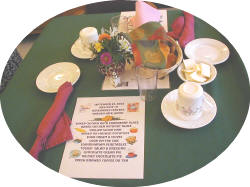 Agnes
credits much of her success in moving from a medical model of dining to a
liberalized one to her staff. She says that by involving them in the change;
making them aware of their progress in decreasing weight losses; bringing
them out of the kitchen and into the dining room to solicit resident
feedback; sending them up to the neighborhoods to meet individually with
residents about their menu preferences; served to empower her staff and
connect them to the larger picture. �I like to see my staff develop and
grow. They are incredibly successful when given the opportunity to step out
of their functional roles.�
Agnes
credits much of her success in moving from a medical model of dining to a
liberalized one to her staff. She says that by involving them in the change;
making them aware of their progress in decreasing weight losses; bringing
them out of the kitchen and into the dining room to solicit resident
feedback; sending them up to the neighborhoods to meet individually with
residents about their menu preferences; served to empower her staff and
connect them to the larger picture. �I like to see my staff develop and
grow. They are incredibly successful when given the opportunity to step out
of their functional roles.�